
Written by Steve Chiu, Jean Lu, Nina Wu, Joy Yang, Ying Goh
Edited by Annie Kung, Shirley Yaw, Andrew Larracuente
Contributors: Cecelia Ong, Kee Hong Sio, Sarah Chu, Alex Tan, Heather Chen, Eddie Chen
Reclaiming Our Purpose for a Sustainable Future
As the world gathers in Belém, Brazil for the 30th Conference of the Parties to the United Nations Framework Convention on Climate Change (COP30), the Buddhist Tzu Chi Foundation calls upon all faith communities, policymakers, the private sector, and civil society to transform the climate crisis into an opportunity – a critical moment to reclaim our shared purpose of caring for our common home and one another.
For too long, climate change has been framed as an unavoidable cost – a narrative of loss, sacrifice, and alarm. Yet science and lived experience affirm that the solutions before us are not burdens but investments in life itself. Renewable energy is now the most affordable power in history. Sustainable agriculture and infrastructure generate livelihoods, improve the health and well-being of communities, and restore ecosystems. We stand at a moment when humanity possesses the tools, technology, and wisdom to act; what remains to be awakened is the collective will to do so.
Hope as a Moral Imperative
Hope is not denial of reality; it is the courage to act within it. From the Buddhist perspective, crises reveal impermanence and interdependence – the very truths that make renewal possible. Hope, then, must be expressed in tangible action: through ethical choices, compassionate living, and community transformation that heals both people and the planet.
At Tzu Chi’s 9,000 recycling stations and points operating in 21 countries worldwide, millions of volunteers demonstrate daily that change begins from the ground up. Each bottle repurposed, each meal shared, and each life touched becomes proof that climate action is not a distant goal but a present practice.
Human and Social Development: The Transformative Power of Volunteerism
At every touchpoint of its operations, Tzu Chi strives to align action with compassion, ensuring that Buddhist ethics and respect for all life are woven into every decision and relationship.
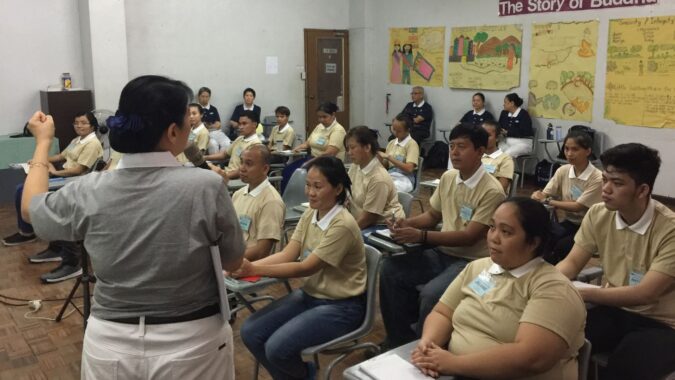
True resilience is built in the hearts of people. Since 1990, Tzu Chi volunteers have shown that environmental protection and social empowerment are inseparable. In communities across Asia, the Pacific, the Americas, and Africa, volunteers mobilize local residents to reduce waste, repair what is broken, and conserve resources, embodying what Tzu Chi calls “social photosynthesis”: the process by which awareness is transformed into collective energy for change. Just as plants transform sunlight into nourishment, communities transform shared understanding into collective action.
From elders sorting recyclables to youth restoring rivers, this spirit of volunteerism fosters a sense of inclusion, dignity, and purpose. It demonstrates that climate adaptation is not only about infrastructure but about building human solidarity. In partnership with governments, UN agencies, and other nongovernmental organizations (NGOs) and civil society organizations (CSOs), Tzu Chi promotes education, livelihood programs, and climate awareness, ensuring that no one, especially not the most vulnerable, is left behind.
Agriculture and Food Systems: Ethical Eating for a Sustainable Planet
Food systems lie at the heart of the climate equation. Global food production accounts for 35 percent of greenhouse-gas emissions, and livestock farming alone accounts for nearly 60 percent of those emissions. Recognizing this interconnection, Tzu Chi promotes plant-based diets across its hospitals, universities, and relief operations worldwide – a commitment rooted in compassion for all beings.
Initiatives like Ethical Eating Day and the Healthier Me 21-Day Challenge in Singapore have encouraged thousands to adopt sustainable and healthy diets, with 63% of participants reporting measurable health improvements after three weeks of consuming plant-based meals. Tzu Chi also advocates for policies grounded in equity, ethics, and sustainability at UN forums such as the Food Systems Summit, the annual COP, and the annual UN Environment Assembly. When people eat with reverence, they nourish both body and planet.
Cities, Infrastructure & Water: Local Solutions for Global Transformation
Urban resilience begins with ethical infrastructure and mindful living. Through DA AI Technology, Tzu Chi’s partner in transforming discarded PET bottles into eco-products for disaster relief, Tzu Chi demonstrates how circular economies can thrive in practice. Every eco-blanket, mobile kitchen, mobile water purification system, and other compassionate technologies not only reduce plastic waste but also provide warmth and dignity to disaster survivors worldwide.
Tzu Chi’s volunteer-driven recycling network diverts millions of tons of waste from landfills annually, fostering community cohesion and promoting sustainable innovation. Its environmental education stations serve as living laboratories where community members learn to link personal habits with planetary health, cultivating a culture of gratitude that is as important as any technological solution. These initiatives demonstrate that the path to resilient cities begins not only with policy, but also with people.
Building Enabling Environments for Empowerment
COP30 underscores that localization is key to resilience. From community recycling in Sri Lanka to eco-education in Malaysia, Tzu Chi has localized global climate commitments through grassroots education, interfaith collaboration, and volunteer-led projects in 21 countries. Through these efforts, policy principles become living practices.
Partnerships with faith organizations amplify impact at the local level. As a member of the UN Climate Technology Centre and Network and the UN Environment Programme (UNEP) Faith for Earth Initiative, Tzu Chi helps translate international agreements into community-based action that empowers citizens to adapt, innovate, and lead. Addressing climate change is not a cost to development, but a precondition for it.
Our Collective Purpose
Buddhism acknowledges the reality of interdependence. We are inextricably connected. When we vow ourselves to non-harm, we are protecting both our neighbors and ourselves in the same breath. This connection ties all beings together – humans, animals, and the Earth – in a single web of life, each reliant on the others for survival and flourishing. The Buddha taught that we should cultivate boundless love for every being, just as a mother would love her child.
Building upon this sacred teaching, Dharma Master Cheng Yen reminds us that such love must be expressed into action: “We must love the Earth with utmost sincerity. The power of love from everyone together is the greatest protection.”
This is our collective why. In the face of climate change, we are called not only to reduce emissions but to revive our capacity for care. Across the globe, Tzu Chi volunteers prove that hope multiplies when acted upon.
Our Call to Action
Let COP30 be remembered as the moment the international community chose compassion over complacency, opportunity over crisis, and flourishing over fear.
We urge leaders to:
Reframe Financing for Life, Not Loss
Redirect subsidies and financial flows toward renewable energy, sustainable food systems, and circular economies that uplift lives and livelihoods. Channel public funds into community solar, waste-to-value enterprises, and youth-led green innovation hubs – initiatives that demonstrate how climate action generates jobs, health, and dignity. Expand climate education and ethical living programs in schools, workplaces, and communities – equipping people with practical tools for sustainable living, so that hope becomes a civic skill, expressed through daily choices, not merely a sentiment.
Integrate Compassion in Decision-making
Adopt metrics that account for social well-being, ecological restoration, and ethical consumption alongside GDP. Reward institutions and enterprises that embed compassion into production, like DA AI Technology’s transformation of discarded PET bottles into relief blankets and eco-textiles that both reduce waste and serve humanitarian needs. Integrate sustainable procurement and plant-based catering into public institutions to normalize low-carbon, ethical choices.
Empower Communities to Lead the Transition
Integrate grassroots and faith-based organizations into national climate strategies. Support local governments and interfaith coalitions in scaling proven models, such as Tzu Chi’s 9,000 community recycling stations across 21 countries and its plant-based humanitarian kitchens during disaster response. Allocate direct climate adaptation funding to community networks that already reach the most vulnerable, ensuring that resilience is built where people actually live.
Build Systems that Uplift and Scale Volunteerism
Enact policies that recognize volunteerism as a pillar of national resilience. Provide small grants, training, and insurance coverage for community-led environmental projects. Reform education curricula to include ecological ethics and hands-on service, cultivating the next generation of environmental stewards and changemakers. At the global level, align climate financing mechanisms to reward behavioral change, community ownership, and intersectoral collaboration as essential climate investments.
We call upon leaders and members of faith communities, governments, the private sector, and civil society at COP30 to stand united at this turning point – where pledges become practices, and where compassion becomes the measure of progress.
Let this be the moment where we affirm that development must be aimed at empowerment. Let us invest not only in technology, but also in people; not only in infrastructure, but in conscience. When governments enable communities, when faiths unite across differences, and when every person acts with compassion, the world itself becomes our shared temple. Together, we can transform this era of crisis into an age of compassionate renewal – proving that hope, when lived, is the most powerful climate solution of all.